
Webhook gateway
What is a webhook gateway?
A webhook gateway is the reliability and security layer between the services that send you webhooks and the endpoints that consume them — handling authentication, durable delivery, throttling, fan-out and observability so your application doesn't have to. Webhook Relay is the webhook gateway that also delivers to internal and on-prem services with no public IP, and the same account sends your own webhooks to your customers.
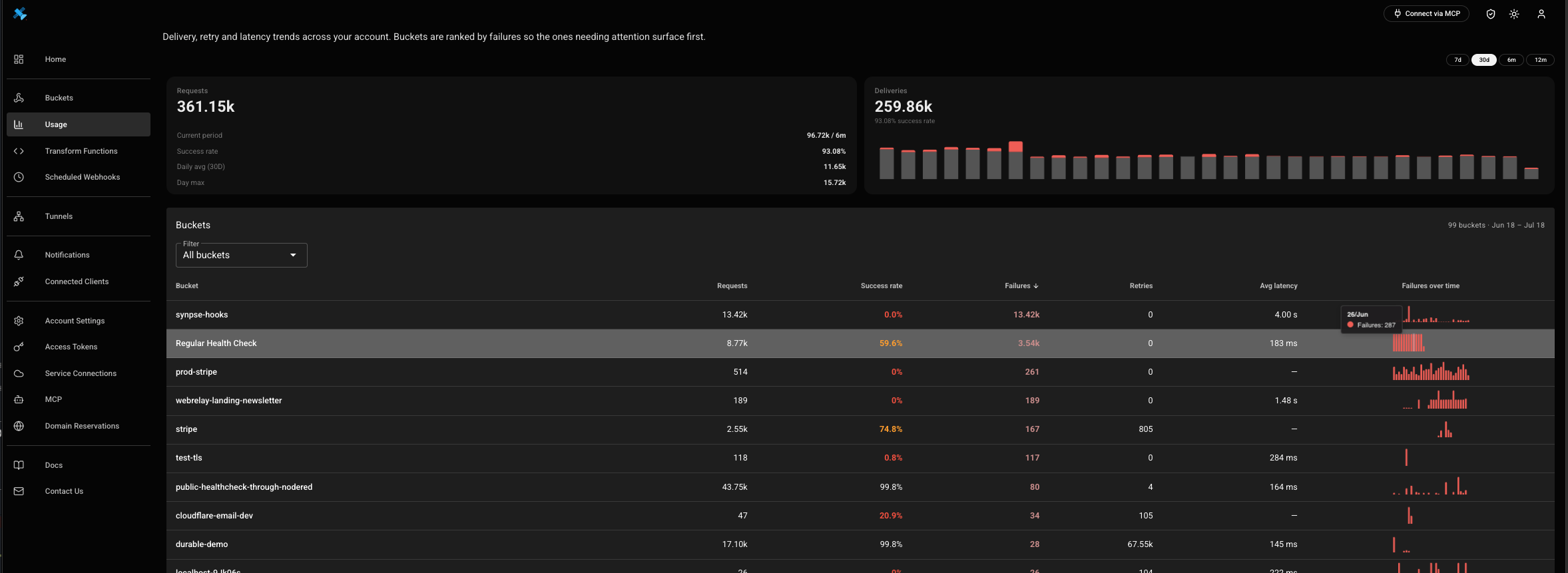
A webhook gateway, defined
Webhooks look simple — one service POSTs to a URL when something happens. In production they're anything but. The sender fires whenever it wants, retries a handful of times (if at all), and gives up. Your endpoint has to be online, fast, authenticated and idempotent every single time, or the event is gone. A webhook gateway sits in the middle and takes on that hard part: it accepts every event, verifies it's genuine, stores it durably, and keeps delivering — at a pace your endpoint can handle, to as many destinations as you need, with a full log of what happened.
Think of it as an API gateway's counterpart for asynchronous, event-driven traffic. An API gateway fronts the requests you receive and route synchronously; a webhook gateway governs the events other systems push to you, where the hard problems are reliability and delivery rather than routing a live request.
Why not just receive webhooks yourself?
You can — until the day you can't. Everything a gateway does is something you'd otherwise build, operate and debug on your own.
A deploy drops events
Restart your service for 30 seconds and every webhook that arrives in that window is lost, unless something is holding and retrying them.
A spike takes you down
A provider replays a backlog and thousands of events hit at once. Without throttling, the flood, not the traffic, is what breaks you.
Signatures aren't verified
Every provider signs differently. Getting HMAC verification right for each one — and rejecting forgeries — is fiddly, security-critical work.
Nobody can see what happened
"Did that webhook arrive?" becomes an archaeology project across app logs, instead of one searchable record of every delivery.
Build vs. buy
A basic receiver that returns 200 is easy. Making it reliable is where the cost hides — you end up building and operating:
- a durable queue that survives restarts,
- retry logic with exponential backoff and jitter,
- a dead-letter queue and a replay UI,
- idempotency and de-duplication,
- signature verification for every provider,
- metrics, logs and alerting,
- and the scaling work when one provider suddenly sends 50× the traffic.
That's weeks-to-months of engineering for infrastructure that isn't your product. Buy when you want those guarantees out of the box or need to reach private destinations; build only if webhook ingestion is itself your core product.
What a webhook gateway does
Six capabilities separate a real gateway from a bare endpoint. Webhook Relay ships all of them.
Durable delivery
Every event is persisted the moment it arrives and retried with exponential backoff for up to 30 days — surviving outages, deploys and flaky endpoints.
Durable retries ->Authentication
Verify each provider's signature so you only process genuine events, and forward with the credentials your endpoint expects.
Verify signatures ->Throttling
Pace delivery to a rate or concurrency your endpoint can handle, with backpressure — so a burst or a replay never flattens a fragile service.
Throttling ->Deliver to many destinations
Fan a single webhook out to up to 200 endpoints at once — production, staging, a backup, an analytics sink — configured once and delivered reliably.
Multiple destinations ->Delivery to internal servers
Push events to localhost, on-prem and private endpoints with no public IP, through a lightweight outbound agent. The capability most webhook gateways lack.
Internal destinations ->Observability
Every delivery logged with its request, response, status and latency — searchable, inspectable and one click to retry or replay.
Webhook logs ->The gateway that reaches your private endpoints
Every other webhook gateway assumes your consumer has a public URL. Most real services don't — they run behind a firewall, inside a VPC, on a Kubernetes cluster, or on a laptop during development. Webhook Relay delivers there too.
A lightweight agent opens an outbound connection from your network, so events are pushed to localhost, on-prem servers and internal APIs without exposing a single inbound port. It's the tunnelling heritage of Webhook Relay combined with a full delivery gateway — a pairing other webhook gateways don't offer.
Deliver to internal services ->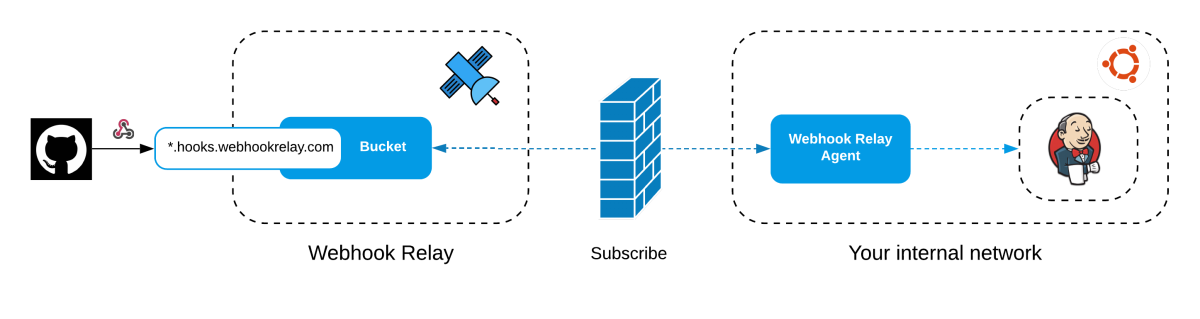
How Webhook Relay compares
Hookdeck, Convoy and Svix are strong webhook platforms. Here's how Webhook Relay compares for receiving and for sending webhooks to your customers — where it's ahead, and where it isn't yet.
| Capability | Webhook Relay | Hookdeck | Convoy | Svix |
|---|---|---|---|---|
| Durable retries | ✓ | ✓ | ✓ | ✓ |
| Signature verification | ✓ | ✓ | ✓ | ✓ |
| Fan-out to multiple destinations | ✓ | ✓ | ✓ | ~ |
| Throttling / rate control | ✓ | ✓ | ~ | ✓ |
| Payload transformations | ✓ | ✓ | ~ | ✓ |
| Delivery logs & inspection | ✓ | ✓ | ✓ | ✓ |
| Private / on-prem delivery (no public IP) | ✓ | ✕ | ✕ | ✕ |
| Reverse tunnels for localhost | ✓ | ~ | ✕ | ✕ |
| Free testing bin, no signup | ✓ | ~ | ✕ | ~ |
| Send webhooks to your customers (outbound) | ✓ | ✓ | ✓ | ✓ |
| Receiving and sending on one plan | ✓ | ✕ | ✓ | ✕ |
| Standard Webhooks signing by default | ✓ | ~ | ✕ | ✓ |
| 30+ days of outbound history under $50/mo | ✓ | ✕ | ~ | ✓ |
| Outbound priced per plan, not per message | ✓ | ✕ | ✓ | ✕ |
| Embeddable customer portal | ✕ | ✓ | ~ | ✓ |
| Queue destinations (SQS, Pub/Sub, Kafka) | ✕ | ✓ | ✕ | ~ |
| Self-hostable open-source server | ✕ | ✓ | ~ | ✓ |
Summary of each platform's public plans and docs, checked October 2026. Hookdeck's outbound column is Outpost, a separate product from its Event Gateway; Svix's inbound product is Svix Ingest. Webhook Relay's customer portal and queue destinations are the next phase. Details: Svix, Hookdeck, Convoy and all webhooks-as-a-service options. "Private delivery" means production delivery to endpoints with no public URL, not a dev-only CLI tunnel.
Webhook gateway FAQ
What is a webhook gateway?
A webhook gateway is a service that sits between the systems sending you webhooks and the endpoints consuming them. It authenticates incoming events, stores them durably, retries failed deliveries, throttles bursts, fans out to multiple destinations and records every delivery — so your application receives reliable, verified events instead of a raw firehose it has to defend against.
Is a webhook gateway the same as an API gateway?
No. An API gateway fronts synchronous requests that clients make to your API — routing, rate-limiting and authenticating live calls. A webhook gateway governs asynchronous events that other systems push to you, where the hard problems are durability and delivery: making sure every event is captured, verified and delivered even when your endpoint is briefly down.
Can a webhook gateway deliver to localhost or a private server?
Most cannot — they require your consumer to expose a public URL. Webhook Relay is the exception: a lightweight agent opens an outbound connection from your network, so webhooks are delivered to localhost, on-prem servers and internal APIs without opening any inbound ports.
Should I build a webhook gateway myself or use one?
You can build one, but you're rebuilding a queue, durable storage, a retry scheduler, signature verification per provider, throttling and a delivery dashboard — then operating them. A managed gateway gives you all of that per destination with a switch, which is why most teams reach for one once webhooks become business-critical.
Can Webhook Relay send webhooks to my customers?
Yes. The Outbound Gateway sends webhooks from your product to your customers' endpoints: you publish an event once and Webhook Relay signs it with Standard Webhooks headers, retries failures for up to 48 hours, rate-limits each endpoint and keeps 35 days of delivery history. It is generally available on every plan, Free included, self-serve, on the same account you use to receive webhooks, and migrating customers can import their existing whsec_ signing secrets.
Is Webhook Relay a webhook gateway?
Yes. Webhook Relay provides durable delivery, signature verification, throttling, fan-out, transformations and full delivery observability — and uniquely delivers to internal and on-prem endpoints with no public IP. It also sends your own webhooks to your customers. You can start for free and test with a no-signup webhook bin.
Start forwarding webhooks in minutes
Connect a source, pick a destination, and Webhook Relay handles delivery, retries and transforms. Set up your first webhook in under five minutes.
Free plan · No credit card required · 7-day money-back guarantee on paid plans