

Serverless Webhook Transformations
Transform, filter and reshape webhook payloads in flight with Webhook Relay functions before forwarding them to any destination — no extra infrastructure.
Webhook Relay functions transform webhooks in flight. A short JavaScript (or Lua) function runs on Webhook Relay after a webhook is received and before it is forwarded, so you can reshape the payload, rewrite headers, change the method or path, enrich it from another API, or drop it — without hosting a server. It is the fastest way to integrate two services that have no native integration: the provider keeps sending its normal webhook, and the destination receives exactly the request it expects.
How it works
- Point the provider at your bucket's public URL.
- Write a function in the dashboard — or generate a first draft from sample JSON with the automatic transform builder — and attach it to an input or an output.
- Every webhook passes through the function; the result is delivered, retried and logged like any other Webhook Relay delivery, including to internal servers with no public IP.
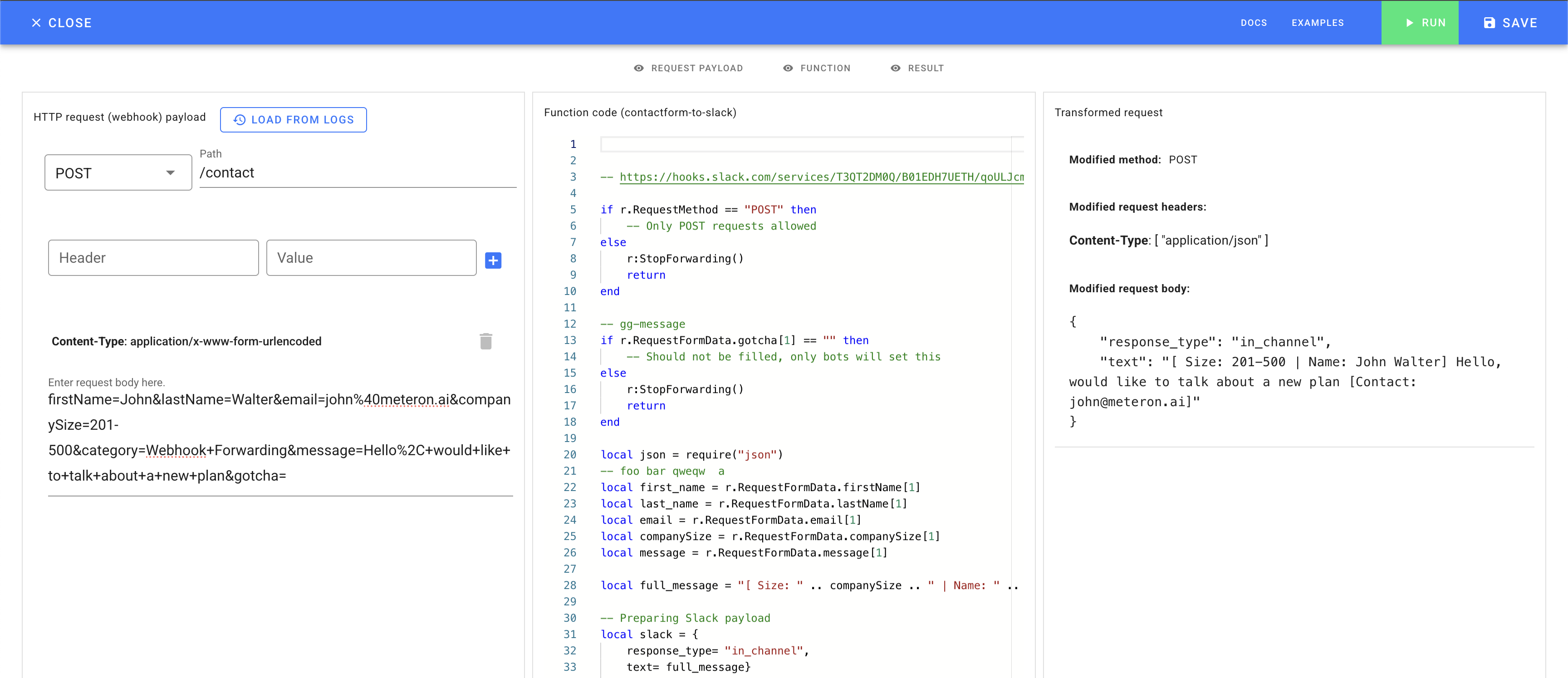
Integrations teams build with functions
- Stripe, Shopify or GitHub events → Slack, Discord or Microsoft Teams messages
- HTML forms and Jotform submissions → clean JSON for a CRM or ticketing API
- TradingView alerts → broker, chat or notification webhooks
- Git push events → an AWX job template or Jenkins job with mapped parameters
- Provider validation handshakes such as the Microsoft Graph validation token
- Any webhook → BigQuery, email or a data warehouse
Functions vs. no-code automation vs. your own cloud function
| Webhook Relay function | Zapier / Make / n8n | Your own AWS Lambda or Cloud Function | |
|---|---|---|---|
| Where it runs | Managed, inline with delivery, retries and logs | Managed workflow tool | Your cloud account |
| Setup | Paste JavaScript in the dashboard and attach it to an output | Visual builder, per-task pricing | Deploy pipeline, IAM, API gateway |
| Delivery to localhost or on-prem endpoints | Yes | No | No |
| Retries, replay and delivery logs | Built in | Varies | You build them |
| Custom code | Full JavaScript or Lua | Limited code steps | Full |
Unlocking Infinite Integration Possibilities
Webhook Relay gives you control of webhook workflows with managed JavaScript or Lua functions. Go beyond simple forwarding to reshape data, filter events, add authentication, change the method or path, enrich payloads, and customize responses. New integrations can start with JavaScript, while existing Lua functions remain supported.
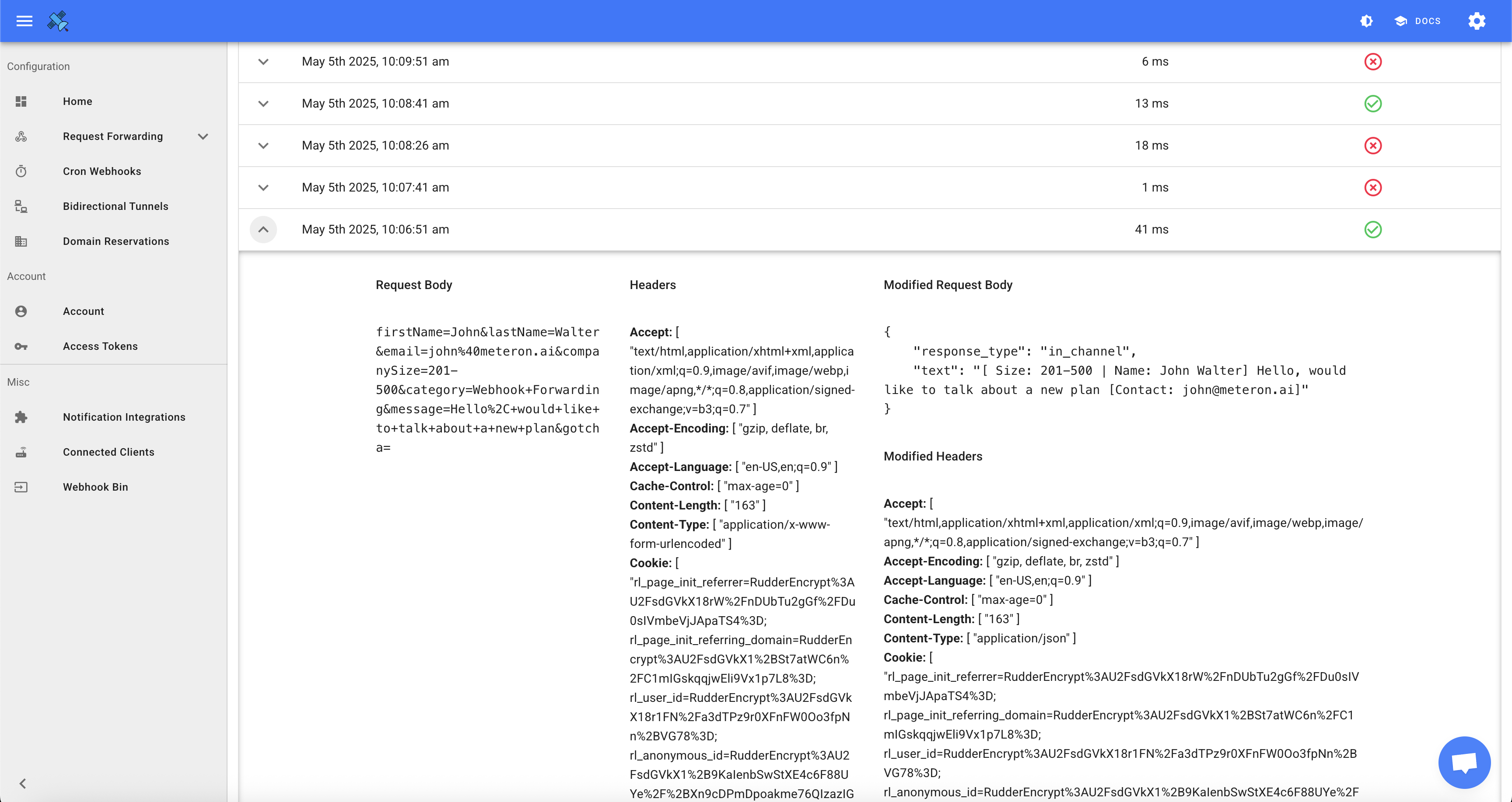
Seamlessly Connect Disparate Systems
Bridge the gap between different platforms and services effortlessly. Imagine transforming order notifications from your e-commerce platform into custom alerts for your trading platform, or automatically routing messages from your website's HTML contact form directly into a dedicated Slack channel. With transformations, you can map data fields, adjust formats, and ensure information flows smoothly between systems that weren't originally designed to talk to each other.
Start with practical examples
The webhook transformation cookbook includes copyable JavaScript patterns for field mapping, Slack and Discord messages, form-to-JSON conversion, filtering, HMAC signing, path changes and validation handshakes. Use the filtering and routing guide when each output should receive a different subset of events.
Helper functions
Webhook Relay provides a set of helper functions that make it easier to transform webhooks:
- JSON encode/decode
- Base64 encode/decode and crypto functions
- Make HTTP requests from within a function
- Send emails
- BigQuery
- Helper libraries for JMESPath, CSV, XML, YAML, JWT, templating and more
Serverless Simplicity, Pay-Per-Use Efficiency
Forget about managing infrastructure. Webhook Relay's transformation functions run entirely in our managed environment. There are no servers to deploy, scale, or maintain. Focus solely on building your integration logic. Plus, with our pay-per-use pricing, you only pay for the compute time you actually consume, making it a cost-effective solution for businesses of all sizes.
Key Benefits:
- Flexible code: Implement transformation logic in JavaScript or Lua.
- Deep Integration: Connect incompatible systems like e-commerce stores, trading platforms, CRMs, and communication tools (e.g., Slack).
- Serverless: No infrastructure management required. Deploy and run transformations instantly.
- Cost-Effective: Pay only for the resources you use.
- Versatile Use Cases: Ideal for connecting e-commerce events, financial alerts, contact forms, IoT device data, and much more.
Start with the functions documentation or generate a first draft from sample JSON in the automatic transform builder.