

Webhook Architecture Diagram: How Webhooks Flow End to End
A clear webhook architecture diagram — from the sender that emits an event to the endpoint that receives it, plus queues, retries and signature checks.
Webhooks are simple in principle — one server POSTs to another when something happens — but a reliable webhook system has a few more moving parts than people expect. This is the webhook architecture, from the event that starts it to the handler that finishes it. (New to the concept? Start with what is a webhook.)
The basic webhook architecture
At its core, every webhook flows the same way:
┌────────────┐   event happens   ┌──────────────┐   HTTP POST    ┌──────────────┐
│  Sender    │ ────────────────► │  Webhook      │ ─────────────► │  Your public │
│ (provider) │                   │  (HTTP POST)  │                │  endpoint    │
└────────────┘                   └──────────────┘   200 OK  ◄──── └──────┬───────┘
                                                                          │ enqueue
                                                                          ▼
                                                                   ┌──────────────┐
                                                                   │  Your queue  │
                                                                   │  + workers   │
                                                                   └──────────────┘
- The sender (Stripe, GitHub, Twilio…) detects an event.
- It makes an HTTP POST to the URL you registered, carrying headers (content type, an event-type header, a signature) and a JSON body.
- Your endpoint receives it, returns a fast 2xx to acknowledge, and hands the payload to a queue so a worker can process it without holding up the response.
The components
| Component | Role |
|---|---|
| Sender / producer | The provider that emits the event and POSTs the webhook |
| HTTP request | Method + URL, headers (incl. the signature), and the JSON payload |
| Receiver endpoint | The public URL that accepts the POST and returns 2xx fast |
| Signature verification | Confirms the request is authentic (HMAC) before you trust it |
| Queue + workers | Absorbs bursts and processes events asynchronously |
| Retry logic | Re-delivers events your endpoint couldn't accept |
Production-grade webhook architecture
The basic flow works until real traffic hits it — a deploy drops events, a spike overwhelms a fragile service, a forged request slips through, or you need the same event in three systems. A production webhook architecture puts a webhook gateway between the sender and your services to handle exactly that:
- Signature verification so only genuine events are processed.
- Durable retries so an event survives an outage or a deploy — persisted and retried for up to 30 days.
- Throttling and a queue so a burst becomes a steady, survivable stream.
- Fan-out to multiple destinations so one event reaches your API, a backup and an analytics sink at once.
- Delivery logs so you can see, inspect and replay every delivery.
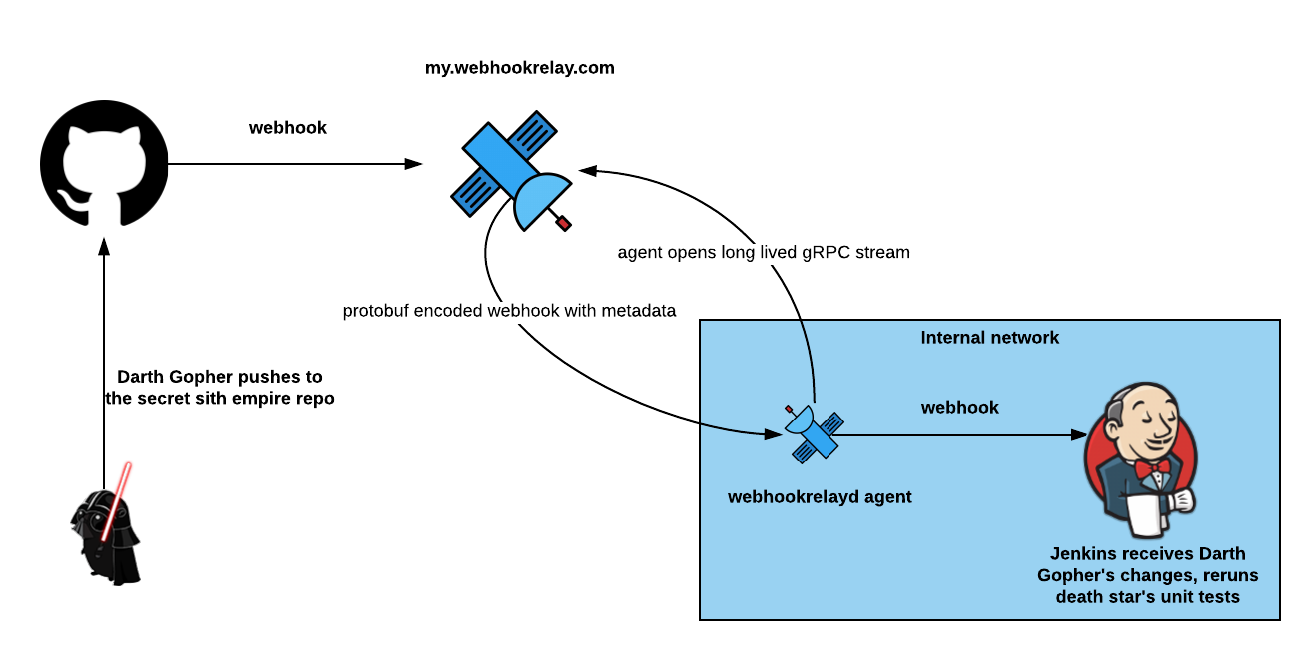
Webhook architecture for local development
There's one more architecture worth drawing: receiving webhooks during development. Providers can only POST to public URLs, but your handler runs on localhost or inside a private network. A reverse tunnel closes the gap:
Provider ──POST──► Webhook Relay (stable public URL) ──► relay agent (outbound) ──► localhost:3000
The relay agent connects outbound, so events reach your machine with no public IP and no open firewall ports — and the URL stays fixed so you configure the provider once. See how to test webhooks.
Build the diagram into something real
- What is a webhook — the anatomy of a single request.
- Webhooks vs API and webhook vs WebSocket — where webhooks fit.
- Webhook security best practices — verification, secrets and idempotency.
Want to watch a real request flow through this architecture? Open a free Webhook Bin and send it a webhook, or start forwarding to localhost for free.