

Best Webhook Transformation Tools in 2026: Hookdeck vs Pipedream vs n8n vs Make vs Cloudflare Workers vs Webhook Relay
Compare the tools that modify a webhook's body, headers or path before forwarding it: Hookdeck, Pipedream, n8n, Make, Zapier, Cloudflare Workers, AWS Lambda and Webhook Relay — with a verdict for each.
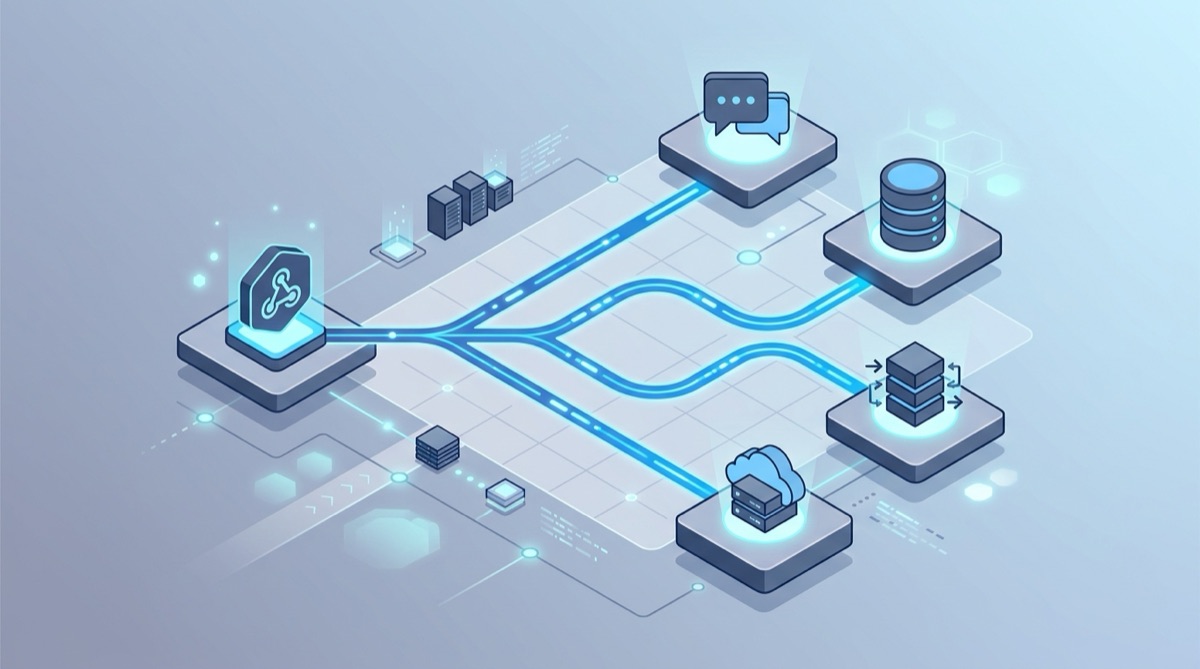
A webhook transformation tool sits between the service that sends a webhook and the one that should receive it, and reshapes the request in flight: map or rename JSON fields, add authentication headers, change the method or path, drop events you do not want, or call another API to enrich the payload. It is how you connect two products that have no native integration without hosting your own middleware. This guide compares the eight tools developers actually use for that in 2026, with a verdict for each.
TL;DR
| Tool | How you transform | Delivers to private / localhost | Retries, replay, logs | Best for |
|---|---|---|---|---|
| Webhook Relay | JavaScript or Lua function attached to an input or output | Yes (agent, Kubernetes operator) | Yes, up to 30 days | Transform-and-forward, including to on-prem and localhost |
| Hookdeck | JavaScript transformation on a connection | Local dev via CLI only | Yes | Public-endpoint webhook infrastructure with transformations |
| Pipedream | Node.js / Python code steps in a workflow | No | Workflow retries | Multi-step workflows that start with a webhook |
| n8n | Visual nodes, Code node | Self-hosted, so yes if you host it privately | Workflow retries | Self-hosted automation with occasional code |
| Zapier | Visual field mapping, Code step | No | Limited | No-code integrations across SaaS apps |
| Make | Visual mapping and routers | No | Limited | No-code integrations with branching |
| Cloudflare Workers | Your own JavaScript at the edge | No | You build it | Owning the code, global low latency |
| AWS Lambda + API Gateway | Your own function | Into your VPC | You build it | Teams already on AWS |
1. Webhook Relay: transform and forward, anywhere
Webhook Relay is a webhook gateway: a permanent public URL per bucket, storage, retries, fan-out and logs, with functions that run on every request before delivery. A function is a few lines of JavaScript (Lua is also supported):
const event = JSON.parse(r.body)

if (event.type !== "invoice.paid") {
  r.stopForwarding()   // drop everything else
  return
}

r.setBody(JSON.stringify({
  text: `Invoice paid: ${event.data.object.amount_paid / 100} ${event.data.object.currency.toUpperCase()}`
}))
r.setHeader("Content-Type", "application/json")
r.setMethod("POST")
Attach it to the output that points at Slack, and Stripe events become Slack messages (full tutorial). The same mechanism rewrites headers and paths, calls other APIs with http.request, reads secrets from service connections, and uses helper libraries for JMESPath, CSV, XML, JWT and templating.
Verdict: the least infrastructure for "receive, reshape, forward", and the only option here that can deliver the result to localhost or a private server. Free plan available; paid from $9.99/month. Start from the functions documentation.
2. Hookdeck: transformations inside webhook infrastructure
Hookdeck ingests webhooks, queues them, and can run a JavaScript transformation on a connection before delivering to a destination. It has a strong console for inspecting and replaying events.
Verdict: a good fit when your destinations are public HTTPS endpoints and you want the queue, retries and console around the transformation. It does not deliver into private networks in production. See the Hookdeck alternative comparison.
3. Pipedream: code steps in a workflow
Pipedream gives you an HTTP trigger and lets you add Node.js or Python steps, with a large catalogue of prebuilt actions. Transforming a webhook is one step; sending the result on is another.
Verdict: best when the transformation is part of a longer workflow (look up a record, branch, notify two systems). Heavier than a single function if forwarding is all you need, and it delivers to public endpoints only.
4. n8n: self-hosted visual automation
n8n is an open-source workflow tool with a Webhook node, a Code node and hundreds of integrations. Because you can self-host it, it can sit inside a private network.
Verdict: strong if you already run n8n or want a visual editor with escape hatches to code. You operate it, including its queue and retries.
5. Zapier and Make: no-code field mapping
Both receive a webhook ("Catch Hook", "Custom webhook"), map fields visually into an action for a SaaS app, and add optional code steps. Stripe to Slack, form to CRM and similar integrations exist as templates.
Verdict: fastest when both ends are popular SaaS apps and nobody wants to write code. Per-task pricing adds up at volume, payload control is limited, and neither reaches private endpoints.
6. Cloudflare Workers, AWS Lambda, Vercel Functions: your own code
A small handler that parses the request, builds the outgoing one, and calls fetch. You own the code, the deployment and everything a gateway would otherwise give you: storage, retries, replay, logging, signature verification.
Verdict: right when you need full control or must keep data in your own account. Expect to build the reliability layer yourself; most teams underestimate that part.
How to choose
- Forward a reshaped webhook to one or more endpoints, possibly private: Webhook Relay.
- Public endpoints with a console and queue, transformation as a bonus: Hookdeck.
- The webhook starts a multi-step workflow: Pipedream or n8n.
- No code, SaaS to SaaS: Zapier or Make.
- Own the infrastructure: Workers, Lambda or Vercel.
Whichever you pick, test the transformation against a real payload first. The free Webhook Bin captures what a provider actually sends, and the transformation cookbook has copy-paste patterns for field mapping, chat messages, form-to-JSON conversion, filtering and HMAC signing.